
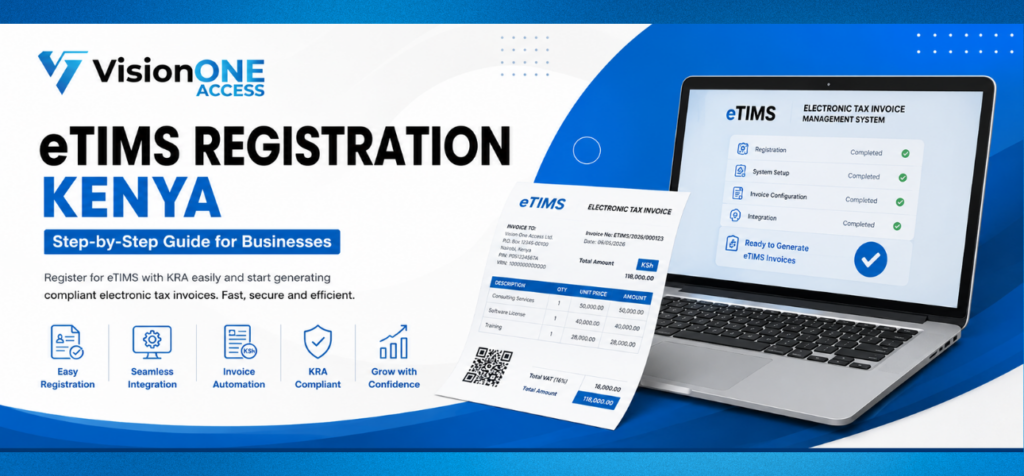
eTIMS registration Kenya is essential for businesses that want to comply with Kenya Revenue Authority invoicing regulations. Businesses must register correctly to generate compliant electronic tax invoices. Therefore, understanding the registration process helps companies avoid compliance issues and operational delays.
Moreover, KRA continues expanding digital tax compliance across Kenya. As a result, businesses in Nairobi, Mombasa, Kisumu, and other regions increasingly adopt eTIMS systems.
VisionOne Access helps startups and enterprises simplify eTIMS onboarding, setup, and compliance integration.
What is eTIMS Registration Kenya?
The eTIMS registration Kenya process allows businesses to enroll in the Electronic Tax Invoice Management System developed by KRA.
This system enables companies to:
- Generate electronic invoices
- Submit invoice data to KRA
- Improve VAT compliance
- Automate invoicing workflows
Additionally, businesses can integrate eTIMS with ERP and accounting systems.
Why Businesses Must Register for eTIMS
KRA introduced eTIMS to improve tax transparency and digitize invoice management. Therefore, many VAT-registered businesses must complete registration.
Key Reasons for eTIMS Registration
- Compliance with KRA regulations
- Accurate tax reporting
- Reduced invoice fraud
- Faster invoice validation
- Better financial transparency
Moreover, registered businesses improve operational efficiency through automation.
Official Website:
Kenya Revenue Authority (KRA)
Requirements Before Starting eTIMS Registration Kenya
Businesses must prepare several documents before beginning the registration process.
Required Documents and Details
- Valid KRA PIN
- Business registration certificate
- VAT registration details
- Company contact information
- Authorized representative details
Additionally, businesses should review their invoicing systems before onboarding.
How to Register for eTIMS Step-by-Step
Understanding how to register for eTIMS helps businesses avoid setup mistakes.
Step 1: Access the KRA Portal
First, visit the KRA iTax portal.
Then, log in using your business KRA PIN credentials.
Step 2: Select eTIMS Registration
Next, choose the eTIMS registration option from available services.
Additionally, businesses must select the preferred integration method.
Step 3: Complete Business Information
Enter business details carefully.
This includes:
- Company name
- VAT details
- Business location
- Contact information
Moreover, businesses in Nairobi commercial areas like Westlands and Upper Hill commonly use automated integration systems.
Step 4: Choose eTIMS Solution Type
KRA offers multiple eTIMS setup options.
Common Solution Types
- Web Portal
- Online Portal Integration
- System-to-System Integration
- Mobile Application
Therefore, businesses should select a solution matching their operational needs.
Step 5: Verify and Submit Application
Review all information before submission.
Then, submit the registration request through the portal.
Consequently, KRA reviews and validates the application.
Step 6: Receive Approval and Setup Access
After approval, businesses receive access credentials and setup instructions.
Additionally, companies can configure invoice templates and integrations.
KRA eTIMS Registration Methods Explained
Different businesses require different onboarding methods. Therefore, KRA provides flexible registration options.
Web Portal Registration
Suitable for small businesses with low invoice volume.
Online Integration Registration
Ideal for medium-sized businesses needing automation.
ERP System Integration
Best for enterprises using ERP and accounting platforms.
Mobile App Registration
Useful for businesses requiring mobile invoicing access.
Moreover, businesses can scale integrations as operations grow.
eTIMS Setup Kenya: What Happens After Registration?
Completing registration is only the first step. Therefore, businesses must complete the eTIMS setup Kenya process properly.
Post-Registration Setup Tasks
- Configure invoice templates
- Integrate ERP systems
- Test invoice generation
- Verify tax configurations
- Train finance teams
Additionally, businesses should conduct system testing before full deployment.
Common Challenges During eTIMS Onboarding Process
Many businesses experience setup challenges. However, proper planning simplifies implementation.
Common Onboarding Issues
- Incorrect tax configurations
- ERP integration errors
- Invoice validation failures
- Limited technical knowledge
- Compliance misunderstandings
Therefore, many businesses work with experts like VisionOne Access.
Why VisionOne Access is a Trusted eTIMS Partner
Businesses need technical and compliance expertise during onboarding. Therefore, VisionOne Access provides complete eTIMS support solutions.
What VisionOne Access Offers
- eTIMS registration support
- ERP and accounting integration
- Invoice automation setup
- Compliance guidance
- Technical implementation assistance
Furthermore, VisionOne Access helps businesses reduce onboarding delays and compliance risks.
Companies implementing eTIMS registration Kenya benefit from streamlined workflows and expert support.
Benefits of Proper eTIMS Registration
Correct registration improves compliance and operational efficiency.
Key Benefits
- Faster invoice processing
- Improved VAT compliance
- Better audit readiness
- Reduced compliance risks
- Automated invoice management
Moreover, businesses gain real-time visibility into invoicing data.
Best Practices for eTIMS Onboarding Process
Following best practices ensures smooth onboarding and long-term compliance.
Recommended Practices
- Review invoicing workflows before setup
- Choose the correct integration model
- Train finance and operations teams
- Conduct invoice testing regularly
- Monitor KRA compliance updates
Explore Smarter eTIMS Integration Solutions
Businesses exploring eTIMS registration Kenya often need automation, ERP integration, and compliance support.
VisionOne Access provides advanced eTIMS onboarding and invoicing solutions for startups and growing businesses.
Additionally, companies can explore payroll, accounting, ERP, and invoice automation systems to improve operational efficiency and tax compliance readiness.
Looking For Answers?
It is the process of registering a business for KRA’s Electronic Tax Invoice Management System.
Businesses register through the KRA iTax portal using their KRA PIN and company details.
Yes. Businesses can integrate eTIMS with ERP and accounting software for automation.